Monday, 14 October 2013

Stephen Fry's 'Out There'

I've got a bit of a love/hate thing going on with Stephen Fry. I know a lot of people who feel very strongly about him in good and bad ways, and I pretty much agree with them all. I got so annoyed when I read his first autobiography Moab is my washpot, it read to me like public school propaganda, he also infuriated me with the language he used about gay sex, which I'll get onto later. However, his passion in documentaries such as Last Chance to See and his America series was really infectious. I also met him at a book signing for when he wrote a foreword to a collection of Oscar Wilde's short stories, he did a reading from it, which was beautiful, and he was extremely likable. I suppose most people who I know who despise him base this largely on the fact that he purports to be an anti-establishment figure, when he is quite clearly the exact opposite. All this aside, I watched Out There on BBC2 with some interest, hoping it would make up for the laughable BBC3 documentary about being gay in Uganda hosted by Scott Mills of all people.

However, it troubled me in many ways. Obviously, a lot of the stories shared in the documentary were heartbreaking, but it was the way the documentary was framed that I'm focusing on here. I was bothered by the following:


  • Fry's use of the word 'gay'. It was 'gay people this' and 'gay people that'. The inference being 'gay men'. We heard from one lesbian, but apart from that, the language used was very exclusive, and while it's understandable that, at least in the UK, a lot of legislative changes around queer issues have been focused around gay men, that's not to say that issues of homophobia don't concern lesbians, bisexual men and women and trans people. If anything, gay men are the ones whose lifestyles have most broadly been accepted in this country. If you're referring to the LGBTQ community, then address it as such, not the gay community.
  • On the subject of language, stop saying 'homosexuality' it's a dated and scientific term that we really need to move away from. Most annoyingly though, and this was my main issue with Moab... is that he insists on calling anal sex "sodomy" or "buggery", both were words used to prosecute and to animalise people. While Fry rightly argued against people assuming that (again, male) gay relationships were purely about anal sex, by saying that anal sex most regularly occured between mixed-sex couples, his defensive tone and assertion that most gay men don't have anal sex was extremely offensive. It's not really moving away from prejudice to steep a very common and natural part of sexual activity in your community with shame by denying it exists, or referring to it in such heinous terms. Of course, it's a nice soundbite to say that queerness is not about sex, it's about love, but of course, it's also definitely about sex.
  • Stephen Fry and Elton John as the voices of the gay male community makes me shudder. One is a man ashamed of gay sex, the other has assimilated so willingly to a heteronormative life. Of course I'm not assuming that there's anything wrong with people wanting to get married and have children, I think it's great that people have the option, but surely we've moved beyond this being the pinnacle of queerness.
  • Finally, it ended with a white rich gay actor who is successful in Hollywood, and another man who was being trained to shed any hints of effeminacy he might have, as that is the only way he felt he could achieve anything as an actor. I really don't think narratives about these exceptionally privileged people deserve the same platform as a lesbian who was "correctively" raped as a 14 year old, forced to have an abortion and given HIV/AIDS, or an underground medical support group in Uganda for those too scared to seek help through traditional avenues given impending death-sentence laws. Again I'm not suggesting that varying degrees of prejudice aren't worthy of conversation, but I think it trivialises the real issue to contrast them in this way.
  • I also didn't like the way he kept saying "one of the few people brave enough to speak to us", I don't think braveness should be measured that way. This suggests that the queer people who are suffering immensely who don't speak on television are not brave. It's deeply troubling. Lastly, I think it was a bit regressive for him to say to a "gay cure" doctor "you could pass as gay because you're so well groomed" I see what he was trying to do, but let's not enforce stereotypes.


Apologies this is a bit of an incoherent rant, I'm just tired of seeing issues such as these being handled so poorly. I learnt nothing from this documentary, but that's fine, I wasn't the intended audience, I follow queer politics around the world quite closely, but if this show was aimed to educate people, let's not educate them within such troubling and tedious heteronormative parameters. Do I admire Stephen Fry? A little. Do I like him? A lot. Does he speak for my queer community? Absolutely not.

Tuesday, 1 October 2013

Black History Month: Dido Elizabeth Belle

To celebrate Black History Month, Sutton House, Hackney has an exhibition for October & November called Influential Black Londoners, featuring letters from admirers written to historical Black figures who have helped to shape London and beyond. As part of this, I helped to research three of the figures, the one who captured my imagination the most was Dido Elizabeth Belle. As a taster for the exhibition, I thought I would share my research about her. The exhibition will continue to evolve with the inclusion of art works created by children, so make sure you check it out.


Royal Naval Captain John Lindsay captured a Spanish ship around 1763 and on it met a black slave woman, whose name is unknown. Together they had Dido Elizabeth Belle, named perhaps after the queen of Carthage. What became of her mother is unknown, but Dido was sent to live with her great uncle William Murray, Lord Mansfield at Kenwood House, London, while Lindsay was at sea. Dido was raised alongside her cousin Elizabeth Murray, whose mother had died young and whose father was an Ambassador in Austria and Paris. Life at Kenwood was largely pleasant for Dido, for although she ate her meals alone and was greeted with discomfort, and sometimes hostility from visitors to the house, she had a strong companion in her cousin Elizabeth and was treated with great affection by Lord Mansfield, an affection thought to have played a large part in the Mansfield Ruling of 1772, which decreed that no slave could be taken abroad by force. Dido ran the dairy and poultry yards at Kenwood, and received a handsome allowance, though it was significantly smaller than her cousin’s. In 1785 Elizabeth left Kenwood to marry, and three years later, Dido’s father died, leaving £1000 for her in his will. Lord Mansfield died in 1793 and left her £500, plus £100 per year for life. In his will he confirmed Dido’s freedom, the word ‘confirmed’ suggesting that she had lived her life already as a free person.

The portrait of Dido and her cousin, originally thought to have been painted by Johann Zoffany, but later attributed to an unknown artist, is striking in many ways. In contrast to many earlier portraits, such as Anthony van Dyck’s 1634 painting Princess Henrietta of Lorraine Attended by a Page, and to portraits that followed, including Manet’s Olympia, the black figure in the painting is given an almost equal prominence to their fellow white sitter, and has clearly been rendered with the same care and attention. The unknown artist, whilst ignoring conventions of presenting the black sitter as an accessory for the white sitter, usually denoting status or wealth, still hints at an inequality. Dido is seen pointing to her face, perhaps to highlight the differences in skin colour with her cousin, she is also stood slightly behind Elizabeth, reminding us of the ambivalence of Dido’s role at Kenwood house which fell somewhere between being treated as a proper member of the family, and being treated as a servant. The clothes the two cousins wear are at odds as well, as Dido is exoticised, which may indeed be a way of asserting the status of Elizabeth, especially since accounts of visitors to Kenwood House suggest that Dido dressed in much the same clothes as Elizabeth. Even so, this painting is assumed to have carried a pro-abolitionist message and serves as a reminder that the role of black people in aristocratic families and historic houses, even in the late 18th and early 19th centuries.

Viscountess Weymouth (née Emma McQuiston) has made the news recently for becoming Britain’s first black future marchioness. She married Viscount Weymouth and now lives at Longleat House, an unusual stately home in Wiltshire that includes the first safari park outside of Africa in its grounds. While relishing the traditions bestowed by her newfound title, McQuiston is using her status to help elevate her own brand, as she promotes healthy eating through her recipes and provides beauty tips and advice. Whilst notable for her new title, the Viscountess is just one of many black women and men with a prominent role in the British aristocracy, many others including Dido, have often been overlooked, forgotten or silenced.  

In 1794, Dido is thought to have married John Davinier and had three sons, twins Charles and John in 1795, and Edward William in 1800. Dido died just four years later.

Some useful further reading:
Adams, G. (1984). 'Dido Elizabeth Belle: a black girl at Kenwood'. Camden History Review, 12, 10-14
Minney, S. (2005). 'The search for Dido'. History Today, 55, 2-3.
Roulston, C. (2006). 'Framing Sensibility: The Female Couple in Art and Narrative'. Studies in English Literature 1500-1900, 46 (3), 641-655.
A resource created for an exhibition at Kenwood House

The research was overseen by Patrick Vernon OBE and the research was interpreted by Dr Miranda Kaufman. Artist Jane Porter has created a series of beautiful stamps which are dotted around the house and in the exhibition space. The exhibition runs until the end of November.

Saturday, 28 September 2013

Unusual bedfellows? When the National Trust met Big Brother

I am astounded by the vocal opposition to the National Trust’s collaboration with the Big Brother house that comes not only from the usual offenders such as the Daily Mail and the Telegraph, but also from some waspish Guardian readers: ‘even the National Trust is at the vanguard of dumbed-down Britain these days’, ‘They [the National Trust] will not be getting any more of my money’ and so on. Ann Widdecombe, who has in the past been critical of the National Trust’s attempts to widen its appeal and the definition of heritage (in particular the award winning Soho Stories app “I fail to understand how getting young people to listen to these stories of Soho relates in any way to the important and historic work of the National Trust”), has been equally vocal about the Big Brother House, stating that the house is emblematic of a "tawdry and celebrity-obsessed" society. Ironic really for someone who has made a post-politics career from the likes of Celebrity Fit Club, Strictly Come Dancing and Have I Got News For You.

I’m not suggesting for a second that everyone needs to like, or appreciate Big Brother, I know many people who have good reason for disliking the show. My problem is with people objecting the National Trust giving tours of the house for two days. The expansion of approaches to new heritage does not mean the neglect of traditional heritage; a more inclusive sense of heritage excludes no one. If you’re not a Big Brother fan, I expect you probably didn’t fork out for a ticket to attend a tour. There is no obligation, as a National Trust member, to attend all of the sites they either own, or take over for short term projects, I daresay most members have only ever seen a tiny proportion of the vast wealth of properties belonging to the National Trust. If your instinct at hearing about the Big Brother collaboration is to shred your membership, then your notion of heritage needs reconsidering.

What the objections boil down to, is cultural snobbery. We live in a world where people still consider there to be a difference between “high” culture, or “high” art and popular culture/art. I don’t believe such a distinction exists. John Carey, in his brilliant book What good are the arts? argues much more eloquently than I ever could that there are no rational grounds for assuming a difference between the two (see the chapter called ‘Is ‘high’ art superior?’). The assumption of “high” art is that enlightenment comes from engaging with art work and culture that is approved by those above us, the highly educated, the pre-approved “real” artists. This is the realm of canons and hierarchies that presume a particular uniform standard of what can be considered good. This has massive implications around class, Carey notes ‘high art is exclusive, popular art is receptive and accessible, not aimed at an educated minority’. Criticisms of popular art is that it is purely escapism, and formulaic. Escapism is no bad thing, and to dismiss popular art as mass produced or formulaic is to overlook the ‘established genres and rules of composition’ found in much “high” art, such as impressionism. If we were trying to establish how long it takes something considered trashy, throwaway, popular and mass produced to shift into the space of “high” or “real” art, I suspect Andy Warhol would be a good place to start.

I am, and always have been, a massive National Trust fan. I currently volunteer at Sutton House in Hackney, and have many favourite sites around the UK, including Cragside (Northumberland), Gibside (Tyne and Wear) and Kingston Lacey (Dorset). Growing up in the North East, there weren’t many others in my classes at school who would spend their weekends exploring historic houses and crumbling ruins, my family’s National Trust membership was a notable middle class luxury. The engagement with newer interpretations of heritage have largely been framed in the attempt to attract a younger audience to the National Trust, but my instincts tell me that it’s not an age barrier that the Trust needs to overcome, but a class barrier. Many of the people I met on the tours were not National Trust members, but were interested in hearing about some of the sites I’ve previously mentioned, and were keen to visit in the future. Why? Not because they aren’t “enlightened” enough to have engaged with historic sites before, but because the recent initiative at the National Trust said, quite loudly, ‘we are for you too’. The visitors ranged vastly in age, the youngest in my tours was 16, but I saw many younger children in other groups, and the oldest were elderly people, many of whom were Big Brother fans as well as long-time National Trust members.

I was honoured to be able to be involved in this project, I assisted at the launch party and gave tours on the Friday. The National Trust team were brilliant, Joe, Chloe, Mark and many others, as were the Big Brother team, including one of the voices of Big Brother and producer Lauren. This collaborative effort between Elstree Studios, the Big Brother Team and National Trust staff and volunteers was inspirational and a near-military operation, such was the scale of the visitors in such a short space of time. The visitors who took the tour were delightful to spend time with, enthusiastic about the show, enthusiastic about the opportunity to be a part of history, and to interact with a set that many felt they already intimately knew. The tour went through the camera runs around the house, giving a rare opportunity to see the house through the eyes of the camera men and women and the production staff, before entering the house itself, where each visitor was beckoned to the diary room by the ominous voice of Big Brother, where they could have a photograph in the historic chair. There was also the opportunity to meet ex-housemate, the lovely Jackie Travers, who could speak from much more experience about the house than I, or the other tour guides, ever could. The tour then moved to the gallery to see how the programmes are edited, and the booth where Big Brother sits to communicate with the housemates. It ended in the Big Brother Bit on the Side studio.


We were prompted, in our guide notes, to anticipate any objections to the National Trust’s involvement, but I eschewed this defensiveness unless prompted. Unsurprisingly, the few visitors who raised the controversy shared my views of ‘a lot of fuss over nothing’ and felt that it was a promising and exciting opportunity that they hoped was only the beginning.

One of my favourite moments was speaking to a 16 year old boy who had come with his older sister. He was a Big Brother super fan, and had more to tell me that I could ever tell him about the show. He was itching to get to each new room and when the tour came to an end he did not want to leave. Most movingly, he was telling me that he had heard that two ex housemates, both male, were now apparently an item. He said this without judgement at all, in a way that 16 year old boys when I was that age would never have done. This reminded me that above all else, Big Brother has been a great judgement-free platform for marginalised people, presenting honest and objective insights into the lives of people that are usually framed within sensationalist documentaries or scathing tabloid articles. Of the 14 classic series of Big Brother, we have seen two transgender winners, and two winners with disabilities. The Big Brother series has been a great platform for LGBT people and women too.

Big Brother tells us as much about our society (however you feel about it) as Sutton House in Hackney tells us about Tudor times. If these stories can be shared in a tongue-in-cheek and exciting way, all the better. The Big Brother house is Orwellian, it’s Warholian, it’s the photographs of Dianne Arbus brought to life. And just as importantly, it’s bloody brilliant viewing and has changed the face of television. I’m pleased that this has stirred up debate, but if the debate never moves beyond straight forward snobbery, then I don’t think it is worth pandering to the critics. Ivo Dawnay, the London Director for the National Trust said that the housemates from Big Brother were the aristocracy of today, while tongue in cheek, I think there is some truth in this. These are people who are no more or less important than anyone else, but whose lives become of great interest to the general public. I hope this is the beginning of a really radical time for the National Trust, where the definition of heritage continues to be challenged, refreshed and revisited. Keep your eyes out for future events taking place through Project London.

This has definitely been the most interesting and exciting project I've been involved with in my short heritage career, so I’ll end with a few fan-boy pictures from my (very surreal!) time in the house. (top to bottom, Jackie Travers who helped with the tours, me and Lauren Harries' lightbox in the living room, me and fellow Northerner and National Trust fan- the very handsome Liam McGough, me and Lauren Harries who was just as lovely as I expected her to be).




Wednesday, 21 August 2013

Call for presentations / performances

Unspeakable!
The Eleventh LGBTQ History and Archives Conference
7 December 2013, 9.30am-4.30pm
London Metropolitan Archives, 40, Northampton Road, London, EC1R 0HB

Call for Presentations / Performances

Due to much of LGBT History being shaped around legal and political landmarks relating mainly to the experiences of gay men, other queer voices often go unheard. The eleventh LGBT History and Archives Conference explores the histories and experiences of Trans, Lesbian and Bisexual people. These stories are rarely told and, if presented, often not listened to. Come and make some history.

Contributors are invited to submit proposals for performances, presentations and talks lasting ten-twenty minutes,  which explore marginalised experience within an apparently liberated community. Suggested themes: the creation, control and breaking of boundaries; self-asserted and imposed identities; labelling – the liberation and constraint of language; activism – meeting challenges

Deadline for submissions: 6 September 2013     email: ask.lma@cityoflondon.gov.uk

Tuesday, 30 July 2013

LGBT History app 'Quist'

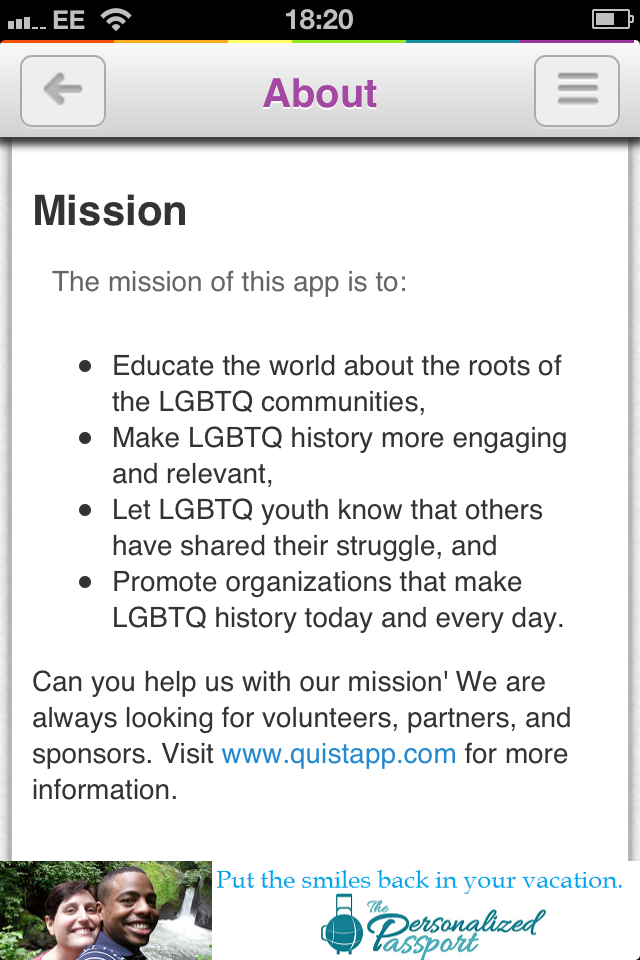
I was alerted to a new app called Quist from this Huffington Post article, and thought (since it's free) I'd download it and give it a go.

I realise it is new, so I presume it will continue to develop and improve, but at a first glance I thought it was a nice idea, but a bit confusingly structured.

It starts by showing you a number (well, two- but presumably this will increase as content is added) of "on this day in history" events, which you can click for further information. Each is accompanied by an image, a location and a year, and a few cursory sentences explaining what happened:


The 'explore' menu allows you to browse the content by location or by date. Obviously there is not a great deal to explore so far, but I suppose the joy of apps like this is that they can constantly be added to, although hopefully this will extend to more of a wiki approach, to make the addition of material more democratic, wide ranging and fast.


So it's not groundbreaking in terms of technology, it's fairly pedestrian, but hopefully could be the start of something quite exciting that allows people to create content, discuss, respond and explore a varied and less political/legal milestone driven approach to queer history.

(ps: attempting to do an image heavy blog has led me to believe that blogspot is not really built for this...)

Tuesday, 18 June 2013

Museum futures in an age of austerity

This weekend was the conference to celebrate 20 years of the MA in Museums and Galleries in Education at the IOE. It was a great opportunity to catch up with some former classmates and to meet professionals and fellow researchers who are making an innovative and inspiring impact on a sector in financial turmoil.

Instead of giving a blow by blow account of the three days, I thought it would be more useful to highlight some of the recurring themes throughout the wide range of papers given, and the three keynote speakers, which John Reeve neatly summarised on the final day. The obvious theme was austerity, and how museum and gallery professionals  are responding to this with creativity and innovation to provide new approaches to museum and education professionals with limited (or often no) funding. Advocacy was another theme, the importance of making the case, to institutions, schools, funders and the government. Another thread running through the conference was the idea of spectacle (in the form of big blockbuster exhibitions) vs engagement and meaning, which Professor Nick Stanley delved into in his keynote on the first day. In a time when many museums are hard pushed to put together blockbuster exhibitions (the definition of which was rightly problematised), curators and educators are finding ways to re-examine and re-interpret existing collections, and experimenting with different ways of approaching this, one of which was another recurring idea, that of the of artist intervention. This was underpinned by the idea of risk, and how many curators feel that artists aren't bound by institutional standards meaning that their interpretation of collections have more room for creativity and rule-breaking, others suggested that curators may be censoring their own innovations in this sense, and that curators and artists are doing much the same thing. The final theme was about voices, particularly other voices, be it two way dialogues with museum visitors, a disruption of authority by inviting non-museum professionals a hand in curating and interpreting, or, as in my own paper, about marginalised voices finding their own ways of claiming heritage.

One of the most interesting and pleasing parts of the conference for me was finding myself in a community of fellow museum researchers, as PhDing can often be a rather isolated (and isolating) affair. I was particularly interested in the papers from other PhD students, and was really encouraged by the wide range of great research taking place. I particularly enjoyed Judith Brocklehurst and Annie Davey's papers, as, although their research includes an element of art practice, they still got me thinking about more unique ways of approaching research. I also enjoyed Nina Trivedi from the University of Westminster, who was arguing that an exhibition catalogue has the potential to be a site in itself, and an alternative curatorial platform that allows contributors more risks that aren't necessarily policed by the institutions as much as the exhibitions themselves.

Another paper I got a lot from was Helen Pike, events programmer from the UCL Petrie Museum of Egyptian Archaeology, where they have a Timekeeper in residence, who questioned the authority of the linear nature of time and the reliance on timelines in museums. This felt like an unquestionably queer critique of museum practice to me. You can find more about this project here.

A great three days, with lots to think about, and a perfect way to celebrate the first 20 years of the MA. Here's to another twenty!

Thursday, 23 May 2013

Some upcoming events


Just plugging a few events.

The first is the 'Museum Futures in an Age of Austerity' conference taking place at the Institute of Education from 14-16 June.

I will be giving my paper on Saturday 15th, it's called:

Fetishising memory: The Holocaust memorial site as gay-cruising ground and the importance of pilgrimage as an affirmative queer experience

The programme is not quite finalised, but keep an eye on the conference webpage over the next few days, you can also buy your ticket for the event there too.

The second is on 27th June 5.30 – 7pm: Room 728, again at the IOE. It is the LGBTQ themed part of the Feminisms, Gender and Sexuality Seminar Series for this term, and I'm delighted to have been asked to present some of my research:

Let’s talk about sexuality: capturing, collecting and disseminating LGBTQ (Lesbian, Gay, Bisexual, Transgender and Queer) oral his and her-stories

(followed by informal drinks in the Student Union Bar)

About the Feminisms, Gender and Sexuality Seminar Series:

Organisers:
Jenny Parkes, Emily Henderson, Charley Nussey, Claudia Lapping, Annette Braun

This group is designed for research students and staff to explore their work around feminisms, gender and sexuality. We meet informally about three times a term, twice during lunchtimes and once during the evening; at each session a speaker is invited to reflect upon their ideas as they develop, and to use the discussion space for the exploration of their own questions. Session topics located within diverse disciplines are encouraged. At least one seminar each term addresses LGBTQ (Lesbian, Gay, Bisexual, Trans, Queer) research. The session to be held in the evening will be followed by drinks in the bar.

To book a place at the seminar, contact Annette Braun at a.braun@ioe.ac.uk.

Also, one final point, my MA dissertation is now available for reference use in the IOE library. The dissertations from 2000 onwards are all up on level 5 and arranged alphabetically by author's surname.


Monday, 20 May 2013

Manchester, so much to answer for...

I've just returned from a long weekend in Manchester, which to my surprise I'm finally learning to love, I think it has been bitterness at the assumption that Manchester is the only decent city up North that has fueled this dislike, but I'm beginning to see its charm.

I visited, at the recommendation of my supervisor (and a friend), the People's History Museum, which was an attempt of mine to find a social history museum that inspired me a bit. This one certainly did. Its origins, and the focus on the history of working people, revolution and democracy means that it's an emphatically left-wing museum. It is described as having no political affiliation, though the permanent exhibition essentially feels like it's about victories for the left, and barriers put in place by the right. It seems to me that any attempt at documenting the history of democracy, equality and protesting has to be slanting left-wise, because that's where the change happened. The main exhibition is divided across two floors, with the first part covering the Peterloo massacres in 1819 up until WWI and then from after the war up to present day.

One thing that particularly struck me, aside from the consistent feminist narrative running throughout, was a piece of text on the inside of a door that opened to reveal a pike head, it said: 'Family legend vs historical opinion- is this a Peterloo pike head?' it then goes on 'The accepted history of Peterloo is that the crowd were unarmed. However some historians have suggested that some members of the crowd were armed. The family who donated this pike head had always believed their ancestor John Chadwick collected it from the field of Peterloo. Museums are often given objects with a family history that differs from that of historians. We have to judge which history to tell. Do you think this is a Peterloo pike head? Should we believe that everyone who attended the meeting wanted it to be peaceful.' It is very unusual to find museums that freely admit that they don't have all of the answers, and instead of making a decision here as to whether or not to show an artefact that may not be what it claims to be, they have framed it within a question, not only about the role of the museum, but about the difficulties of piecing together histories, and allowed the visitor agency in making their own mind. A very bold (and simple) move, for a very bold museum.

The exhibition in the temporary space was The Art of Protest, which consisted of protest artworks (of varying quality) that were submitted to NOISEfestival.com. I particularly liked the use of the space, which seemed very community-curated and democratic, and the exhibition was complemented by a programme of events. Situated in the Engine Hall, the Art of Protest was an example of a community driven short term exhibition, and aside from being a great feature for any museum, also upheld the ethos that formed the original museum collections.

I also popped to the Manchester Art Gallery to see the Raqib Shaw exhibition, and the various interventions he had performed around the museum. I was also delighted to encounter a small exhibition called 'Dreams without frontiers' (which you can read about here), in which I had a near-spiritual experience sitting in a darkened room with 'Asleep' by the Smiths playing and no-one but a woman that looked like Lol from This Is England for company. To accompany the exhibition, a small booklet of essays responding to the works had been commissioned, a piece of art in itself, they had accepted submissions from anyone, and while the quality of the writing varies, it's another example of a democratic use (and extension) of an exhibition.